Cryptocurrencies in 2026: Trends, Risks, and Opportunities

Cryptocurrencies have evolved from niche digital assets into mainstream financial instruments over the past decade. By February 2026, the landscape of cryptocurrencies is more sophisticated, regulated, and globally interconnected than ever before. Investors, traders, and tech enthusiasts alike are exploring innovative blockchain solutions, while traditional financial institutions increasingly integrate cryptocurrencies into their portfolios. Understanding the current state of cryptocurrencies, emerging trends, and associated risks is crucial for anyone aiming to navigate this complex market successfully.
Unlike traditional currencies, cryptocurrencies are decentralized, relying on blockchain technology to validate transactions without a central authority. This decentralization offers benefits such as transparency, security, and borderless transactions, but also presents challenges, including price volatility, regulatory uncertainty, and technological vulnerabilities. As the market matures in 2026, these factors remain central to the decision-making process of both individual and institutional participants.
The Evolution of Cryptocurrencies
Since their inception in 2009 with Bitcoin, cryptocurrencies have undergone significant transformations. Bitcoin started as a digital alternative to fiat currency, aiming to provide a secure, peer-to-peer payment system. Over time, Ethereum introduced smart contracts, enabling decentralized applications and creating a whole new dimension of use cases. By 2026, this evolution has continued, with numerous blockchain platforms offering advanced solutions for finance, healthcare, supply chain management, and decentralized governance.
One major trend in 2026 is the rise of cross-chain interoperability. Unlike earlier years, where each blockchain operated in isolation, modern cryptocurrencies often enable seamless transactions across multiple networks. This not only improves liquidity but also enhances the efficiency of decentralized finance (DeFi) applications. Layer 2 solutions, designed to increase transaction speed and reduce fees, have become essential for high-volume crypto networks. As a result, the market is more accessible and practical for everyday users, while still retaining its innovative edge.
Key Trends in Cryptocurrencies for 2026
Mainstream Adoption and Institutional Investment
In 2026, cryptocurrencies have cemented their presence in mainstream finance. Large corporations, investment funds, and even governments are incorporating digital assets into their financial strategies. Institutional adoption has contributed to more stable market behavior, reducing the extreme volatility that characterized the early 2020s. Banks and payment processors now offer cryptocurrency-based services, making it easier for individuals and businesses to transact in digital currencies.
Retail investors are also participating at unprecedented levels. Cryptocurrency exchanges have enhanced user experience and security, offering intuitive platforms that rival traditional stock trading apps. Education campaigns, both online and offline, have demystified cryptocurrencies for beginners, contributing to broader acceptance.
Regulatory Developments
Regulation remains a pivotal factor in the cryptocurrency ecosystem. By February 2026, many countries have established clear frameworks for digital asset trading, taxation, and anti-money laundering compliance. Regulatory clarity has a dual effect: it builds investor confidence while also imposing stricter compliance requirements on market participants.
Countries with progressive regulations have seen accelerated crypto adoption, whereas regions with restrictive policies continue to experience slower growth. International collaboration among regulatory bodies is also becoming more common, focusing on creating standardized practices that protect consumers while encouraging innovation.
Technological Innovations
Blockchain technology has witnessed remarkable advancements by 2026. Quantum-resistant algorithms, decentralized identity solutions, and advanced privacy protocols are now part of the mainstream conversation. These innovations enhance security, privacy, and efficiency, addressing some of the long-standing concerns that have hindered mass adoption.
The expansion of non-fungible tokens (NFTs) and decentralized finance applications remains a major growth area. NFTs now go beyond digital art and collectibles, offering real-world applications such as tokenized real estate, intellectual property rights, and access to exclusive services. DeFi platforms continue to challenge traditional banking models by offering lending, borrowing, and yield generation without intermediaries.
Risks and Challenges of Investing in Cryptocurrencies
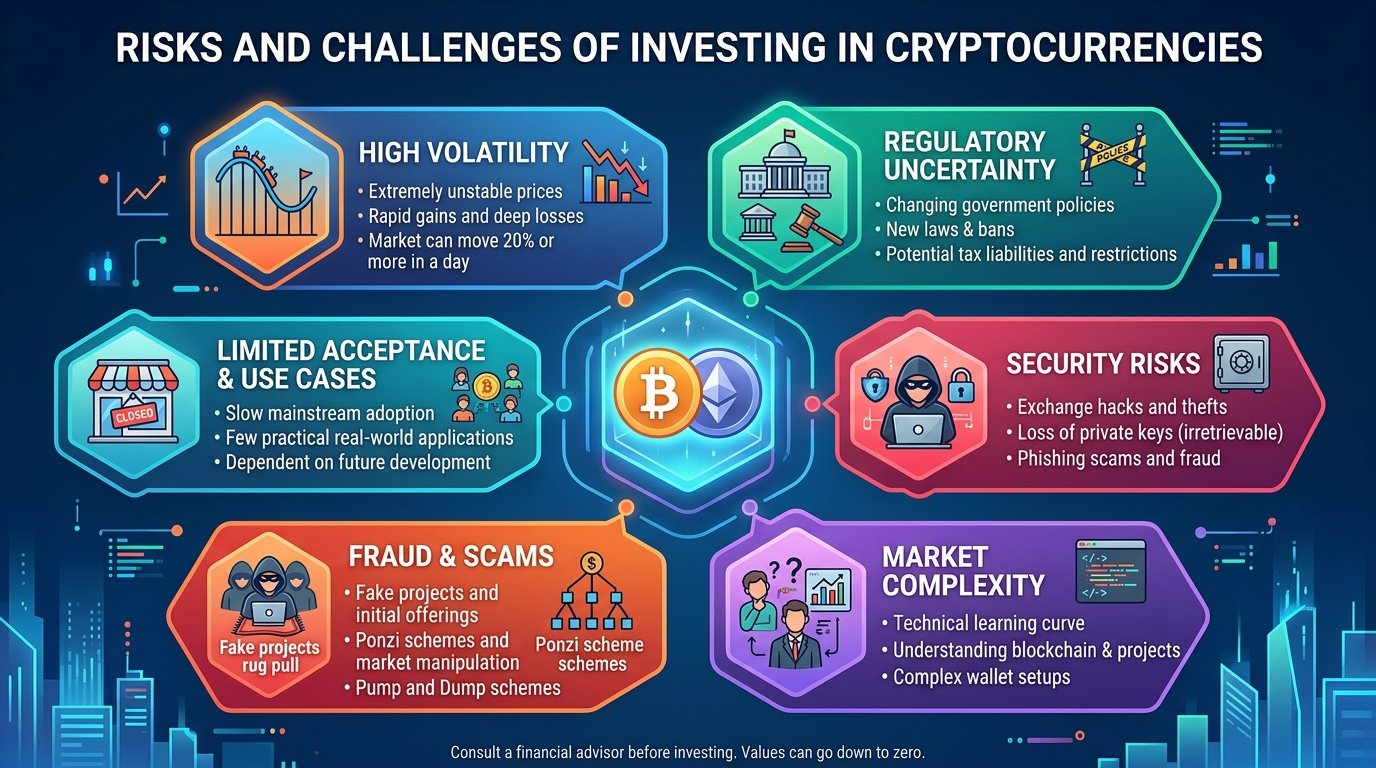
While cryptocurrencies offer remarkable opportunities, they are not without significant risks. Volatility remains a defining characteristic, with prices capable of dramatic swings in a short period. Investors must prepare for sudden changes in market sentiment influenced by technological updates, regulatory announcements, or macroeconomic factors.
Security concerns also persist. Despite advances in blockchain security, cryptocurrency exchanges and wallets are still vulnerable to hacking, phishing attacks, and insider fraud. Custody solutions, insurance policies, and multi-signature wallets are increasingly used to mitigate these risks, but the responsibility largely remains with individual users.
Another challenge is environmental impact. Some cryptocurrencies rely on energy-intensive mining processes, prompting both criticism and innovation. By 2026, a significant portion of the market has transitioned to proof-of-stake or other energy-efficient consensus mechanisms, reducing the carbon footprint while maintaining network security.
Strategies for Successful Cryptocurrency Investment
Investing in cryptocurrencies requires a nuanced understanding of the market. Diversification remains a cornerstone strategy, as spreading investments across multiple assets can reduce exposure to volatility. Long-term holding, often referred to as “HODLing,” continues to be effective for well-established cryptocurrencies like Bitcoin and Ethereum, especially when paired with careful market analysis.
Active trading strategies, such as swing trading and arbitrage, are more suitable for experienced investors. These approaches leverage short-term market movements but require technical analysis skills and disciplined risk management. Emerging tools powered by artificial intelligence and machine learning are increasingly used to identify trading opportunities, predict trends, and optimize portfolio performance.
Education and continuous research are vital. Understanding the fundamentals of blockchain, staying updated on regulatory changes, and analyzing market sentiment can make the difference between success and loss. Participating in community forums, attending industry events, and following credible news sources are all ways investors can remain informed in a fast-evolving environment.
The Role of Decentralized Finance (DeFi)
Decentralized finance has become a cornerstone of the cryptocurrency ecosystem. DeFi platforms allow users to lend, borrow, trade, and earn interest without relying on traditional banks. By 2026, DeFi has matured, with improved security measures, insurance options, and regulatory compliance.
Smart contracts, which automatically execute transactions based on predefined rules, are the backbone of DeFi operations. These contracts reduce the need for intermediaries, lower transaction costs, and increase transparency. Users can access complex financial instruments from anywhere in the world, democratizing access to capital and investment opportunities.
However, DeFi is not without risks. Bugs in smart contracts, liquidity shortages, and malicious actors can lead to significant losses. Careful due diligence, platform selection, and risk assessment are essential for anyone looking to participate in this sector.
Cryptocurrencies and Global Economic Impact

Cryptocurrencies are increasingly influencing global economics. Cross-border payments have become faster, cheaper, and more secure due to blockchain technology. Developing nations benefit from cryptocurrencies as they offer financial inclusion to populations previously underserved by traditional banking systems.
Central bank digital currencies (CBDCs) are emerging as a complementary innovation. While not cryptocurrencies in the strictest sense, CBDCs leverage blockchain technology to enhance monetary policy efficiency, reduce transaction costs, and increase transparency. Their coexistence with decentralized cryptocurrencies is shaping a dynamic global financial ecosystem where traditional and digital currencies interact seamlessly.
Future Outlook for Cryptocurrencies
The outlook for cryptocurrencies in 2026 is cautiously optimistic. Continued technological innovation, broader adoption, and regulatory clarity are expected to drive market growth. However, challenges such as cybersecurity, regulatory divergence, and environmental concerns will require ongoing attention.
Investors and users alike should embrace a balanced approach: leverage opportunities for growth while remaining vigilant about risks. As the cryptocurrency market continues to integrate into mainstream finance, knowledge, adaptability, and strategic planning will be key determinants of success.
Conclusion
Cryptocurrencies in 2026 represent a dynamic, complex, and rapidly evolving landscape. From mainstream adoption to technological innovation, the market offers immense opportunities alongside significant risks. Investors, developers, and enthusiasts must navigate regulatory frameworks, security challenges, and market volatility with careful planning and informed decision-making. The evolution of cryptocurrencies is far from complete, and those who understand the trends, strategies, and underlying technology are likely to benefit the most in the coming years.
FAQs
1. What makes cryptocurrencies different from traditional money?
Cryptocurrencies are decentralized and operate on blockchain networks, allowing secure, peer-to-peer transactions without central authority intervention.
2. Are cryptocurrencies safe to invest in 2026?
While the market is more regulated and secure than ever, cryptocurrencies remain volatile. Proper research, diversified portfolios, and security measures are essential.
3. How does DeFi impact the cryptocurrency ecosystem?
DeFi allows users to access financial services like lending and trading without banks, using smart contracts to automate transactions and reduce costs.
4. What are the main risks of holding cryptocurrencies?
Key risks include market volatility, hacking, regulatory changes, and technical vulnerabilities in exchanges or wallets.
5. How are cryptocurrencies influencing global finance?
They facilitate faster cross-border payments, promote financial inclusion, and complement innovations like central bank digital currencies, reshaping traditional economic models.



Post Comment